Watkins Horse Property Market: What Buyers Should Know
February 19, 2026
February 19, 2026
Are you dreaming of more pasture, a proper barn, and room to ride without giving up access to Denver and DIA? You are not alone. Watkins sits in a sweet spot for equestrian buyers who want acreage plus practical commute options. In this guide, you will see realistic price bands, common horse-friendly features, key Arapahoe County rules, and a clear buyer checklist so you can shop with confidence. Let’s dive in.
Watkins blends new-construction neighborhoods with small-acreage hobby farms and larger ranches. That mix makes public “median” prices jump around. Recent snapshots on major portals placed the median listing price around the low to mid $500,000s and the typical home value near that same range. In a thin market where a single 35 to 40 acre ranch can skew the numbers, it is smarter to shop by price bands tied to acreage and features.
If you want private turnout and a future barn, raw or semi-improved lots in country subdivisions are a common starting point. Recent examples show roughly mid $200,000s for a 2 to 3 acre lot, depending on location and utility readiness. Lots are the lowest-cost path to pasture, but you will need to plan for site work, well and septic, and the full build process. Factor those costs early so your total project stays on target.
Move-in-ready or lightly improved hobby properties often land between about $300,000 and $800,000. Pricing flexes with the home’s condition, fencing, hay and equipment storage, and water setup. A mid-range example in the research was a 7.25 acre property around the low $400,000s. Newer homes on smaller acreage or close-in locations can push toward the top of the band.
In this tier, you will find a wider spread. Some 20 acre fixer-style horse properties have sold in the $400,000s to $700,000s, while improved 15 to 30 acre ranches with functional barns and usable arenas trend closer to $700,000 to $1 million. Condition, usable pasture acres, and arena quality drive value in this band. Be ready to move quickly when a well-cared-for setup hits the market.
Top-tier private facilities and commercial-scale properties usually command seven figures. Recent listings in Watkins included a 40 acre ranch in the low $1.1 millions and a 38 acre property with an indoor arena priced in the mid $1.6 millions. Indoor riding, multiple high-quality paddocks, and large shop or hay buildings are common at this level. These properties are rare, so timing and preparation matter.
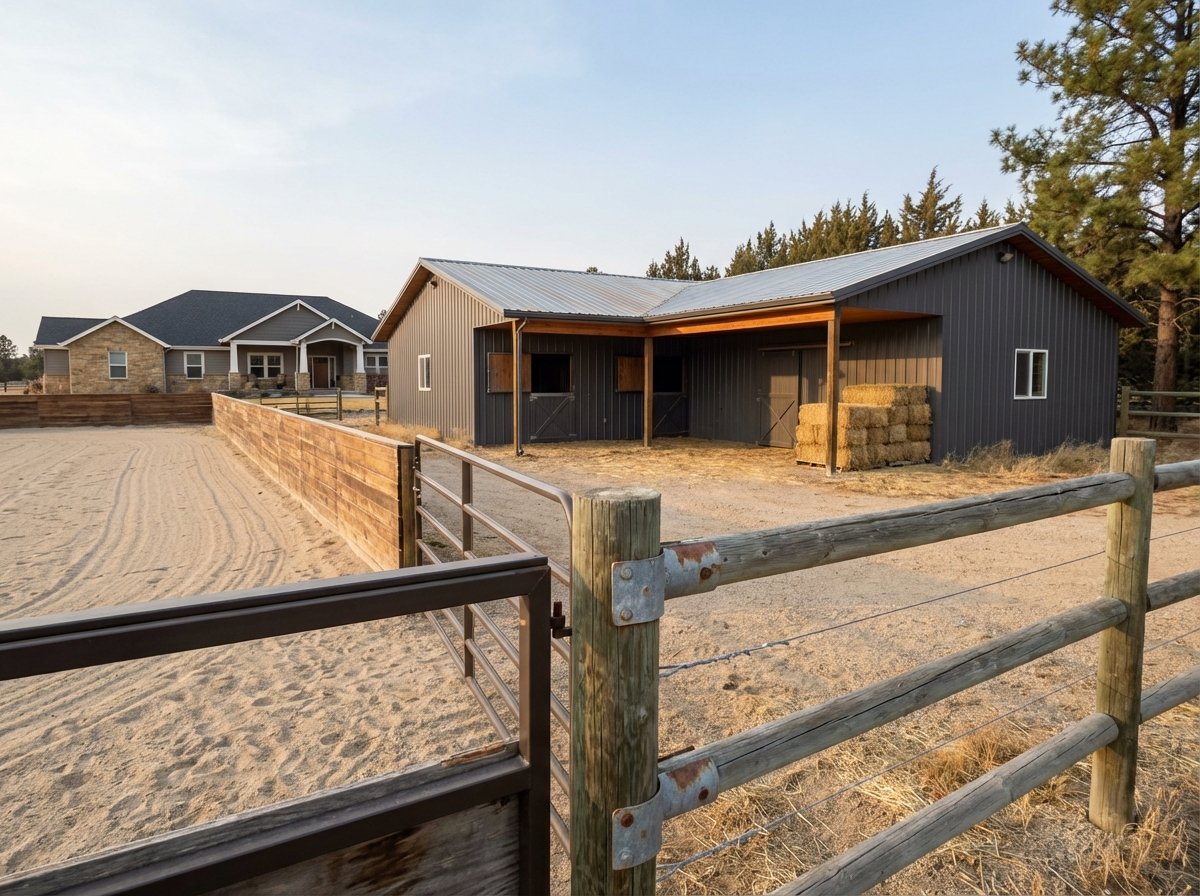
Expect a range from simple loafing sheds to 2 to 20+ stall barns. Larger complexes sometimes include tack rooms, wash bays, and even small apartments. Check electrical, water lines, roof condition, and ventilation. Ask for age and maintenance history.
Outdoor arenas around 90 by 200 feet are common on rural parcels. Higher-end properties may include an indoor arena around 75 by 125 feet or larger. Quality footing and drainage add real value and reduce long-term maintenance. Confirm base depth, material, and how water is managed.
You will often see cross-fencing to create multiple paddocks, with pipe or post-and-rail setups. Heated waterers and separate run-in areas are frequent selling points. Walk fence lines to assess condition and safety. Note any repairs or upgrades you would want to tackle after closing.
Insulated hay storage, designated manure areas, and 30 by 40 foot shops show up on many ranch-style listings. Think through tractor access, trailer parking, and turning radii. Functional storage can save budget you would otherwise spend building later.
RV hookups and 50-amp outlets are common upgrades. Long driveways and county-road frontage make daily use easier, especially in winter. Many buyers choose Watkins for proximity to I-70 and DIA, which helps with both commuting and show travel.
Do not assume every acre is usable for pasture or building. Portions can sit in floodplain, steep terrain, or conservation easements. Listings sometimes note “usable acres,” but you should confirm with a topo map, county plat, and the Land Development Code.
Buying rural or equestrian property means checking a few key boxes before you fall in love with the barn.
Arapahoe County’s Land Development Code sets livestock limits in some conservation and cluster areas. In those areas, large animals such as horses may be limited to one per 20 acres, with smaller livestock at one per five acres. The county can allow more through a Special Exception Use process. Always confirm the parcel’s zoning and any special rules before you plan boarding or multiple riding horses. You can review the Land Development Code for details on livestock, cluster lots, and fencing guidance in conservation areas in the county’s published code. For reference, see the Arapahoe County Land Development Code: Arapahoe County Land Development Code.
Agricultural districts such as A-E and A-1 allow rural cluster options. Under certain conditions, cluster lots can be as small as 2.5 acres when served by on-lot septic and well. That is why you will see both traditional large-lot ranches and smaller country lots in the same area. Confirm any recorded plat restrictions or HOA covenants before you buy. Review the code here: Arapahoe County Land Development Code.
The county prescribes fence types and heights in some conservation and wildlife contexts. Open fence designs and height caps may apply near critical habitats and riparian corridors. If you plan to ride across open range or along streams, verify allowed fence types. Guidance lives in the Land Development Code: Arapahoe County Land Development Code.
In Colorado, new wells require permits through the State Engineer. As a buyer, you should confirm whether an existing well is permitted, what its conditions and allowable uses are, and whether any Denver Basin or augmentation rules apply. Well yield in gallons per minute and volumetric caps matter for equine water needs. Start with the Division of Water Resources well-permitting portal and permit search: Colorado Division of Water Resources well permitting.
On-site wastewater systems are regulated locally. You should verify the current use permit, inspection history, and any required repairs before closing. Some counties require a use permit or final certification at sale. For updates and general guidance, see: Colorado Professionals in Onsite Wastewater.
Grazing and structures can be limited in floodplain or conservation areas. Airport influence zones may also carry noise disclosures and building restrictions. Check FEMA maps and county overlay zones before you assume pasture or building envelopes are unrestricted. Refer to the county code for overlay context: Arapahoe County Land Development Code.
Neighboring Bennett, Strasburg, and Byers typically offer similar acreage and equestrian stock, sometimes with slightly lower per-acre prices. Elizabeth and some Parker-area properties often command higher per-acre values and more luxury-level facilities. Use local MLS comps for the most accurate block-by-block view when you are ready to write an offer. Your agent can help you frame a value range that reflects horse-specific features.
For commute planning, Watkins sits east of Aurora along I-70. It is roughly 25 miles to Downtown Denver and about 13 miles to central Aurora, often 15 to 20 minutes depending on route and traffic. For distance estimates, see this driving-distance reference: Watkins to Denver distance. Always check live maps during your typical travel window.
Use this punch list before tours and again prior to writing an offer.
Ready to talk specifics, walk through current listings, or build a step-by-step plan for due diligence? Connect with a local, owner-led brokerage that lives and works on the Eastern I-70 corridor. Talk with Tania at Look East Realty to get a practical, horse-smart plan for your search.
Discover unparalleled real estate service at Look East Realty. Our commitment to quality and confidentiality ensures your satisfaction. Trust our experienced team to meet all your needs.